
PREVIEW: How ATTENTION Became the World's Most Endangered Resource

Thank you for following Barry’s Substack! This is a Preview of the full version of the Monday feature, available to paid subscribers. All subscribers will receive a full version of the other weekly articles.
The Siren’s Call has pulled Donald Trump off the ship of sanity.
Trump can be satisfied only by recognition from one whom he recognizes as worthy. He seeks recognition and gets, instead, attention.
This fundamental paradox — the pursuit through fame of a thing that fame cannot provide — is the story of the inner lives of most people who dominate our politics and culture. This is the story of Donald Trump’s life: wanting recognition, instead getting attention, and then becoming addicted to attention itself, because he can’t quite understand the difference, even though deep in his psyche there’s a howling vortex that fame can never fill.
So explains best-selling author Chris Hayes, in “Siren’s Call – How attention became the world’s most endangered resource.” A commentator on MSNBC, Hayes knows first-hand what it takes to get, and hold, attention – and why today’s digital distractions are a threat to our mental condition.
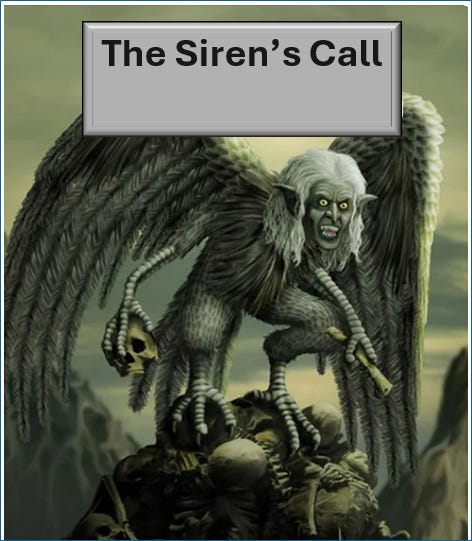
Attention is the essence of life, but it has become something we have surrendered without a fight. The “Siren” Hayes alludes to is the mythical creature, half-bird and half-woman, who enticed passing sailors on passing boats with their irresistible melodies, causing them to steer their ships onto the shores where they would fall into a stupor and die.
Hayes writes about attention that it is the defining resource of our age. Today’s largest companies—Apple, Microsoft, Alphabet, Meta, and Amazon—are primarily attention financing companies. They are fighting in a space where abundant information clashes with scarce attention: information is cheap but attention is costly.
Attention is the leading condition compared to other aspects of speech and communication — persuasion, argumentation, information. Attention comes first. Information is abundant ; attention is scarce. Information is theoretically infinite, while attention is constrained. This is why information is cheap and attention is expensive.
There was a time when this did not matter; when all attention was tribal and close. To go back to life before agriculture, the story of 90 percent of human life on the planet, or to return to the contemporary peoples that live outside of industrial modernity, nearly all time is spent together.
Then social organization and technologies began to pull us apart…began to divide out attention.
How did it happen?
First came the writing. Then came the phoning. Then radios, then came the screens. Each was supposed to end civilization.
“If men learn the art of writing ,” Socrates warned, “it will implant forgetfulness in their souls: They will cease to exercise memory because they rely on that which is written, calling things to remembrance no longer from within themselves, but by means of external marks. What you have discovered is a recipe not for memory, but for reminder.”
The conversation around the evils of phones was just like that classic moral panic. A weekly family magazine in 1910 solemnly advised its readers that the intrusion of phone calls would ruin family life – at a time when calls were flooding into homes at the rate of 1.5 calls per week.
In 1929, as radio rose to become a dominant form of media in the country, The New York Times asked,” Do Radio Noises Cause Illness?” and informed its readers that there was” general agreement among doctors and scientific men that the coming of the radio has produced a great many illnesses, particularly caused by nervous troubles. The human system requires repose and cannot be kept up at the jazz rate forever.”
The New York Post warned that screens are” digital heroin” that turn kids into “psychotic junkies.” “Teens on social media go from dumb to dangerous,” CBS cautioned.
While a bit exaggerated, each development tugged at our dominion over our own minds.
The combination of our deepest biological instincts and the iterative genius of global capitalism means we are subject to an endless process of experimentation, whereby some of the largest corporations in the history of humanity spend billions to find out what we crave and how much of that they can sell us.
The problem with the main thrust of the current critiques of the attention economy, Hayes warns, is that they don’t actually go far enough.
As global incomes rise, and the variety of consumer choices expands accordingly, attentional competition becomes ever more ferocious.
If you neglect a child, it will perish. We are built and formed by attention; destroyed by neglect.
The greatest civilizational challenge humans face or have ever faced, the warming of the planet from human activity, has proven so difficult to solve in large part because it evades our attentional faculties. The most dangerous thing on the planet [CO2] is invisible, odorless, tasteless, and doesn’t actually do anything to you directly.
There are three types of attention-takers: voluntary, involuntary, and social. Voluntary attention is like operating a spotlight. It allows us to focus on chosen stimuli, like reading a novel, by suppressing irrelevant information. Involuntary attention happens without conscious control, like when someone drops a tray of glasses and the clatter grabs our focus. The third type is social attention, where you might be focused on a conversation at a party and you hear your name in another conversation. Your attention shifts instantly. Our brain can process information outside our immediate focus, selectively filtering for words that matter—like our name. This has been dubbed the cocktail party effect.
All these levers are used by media today.
They know that first. you need to grab attention: you need people to tune in to your show, or stop flipping the channels.
A core insight that unlocks a fundamental truth about the entire experience of the attention age: It is easier to grab attention than to hold it. There would be enormous monetary rewards for anyone who figured out a way to bypass holding attention and simply maximize means of grabbing attention iteratively, over and over.
This is part of the approach that Hayes’ own medium, cable news, takes. Look at a cable news screen, and you’ll notice immediately that it is jam-packed with visual stimuli. Interruptions are constant.
Slot machines hold our attention by grabbing it for just a little bit while we wait for the spinning to stop, and then repeating that same brief but intense process over and over. The model is simple : Each play lasts only a few seconds. Bright lights and novel stimuli compel our attention. A moment of suspense is followed by resolution.
This is the core model for most video games, which are one of the major attentional draws. People have now spent more time playing “Call of Duty” than they have spent existing on Earth. Every year, Call of Duty players collectively log some 475,000 years of gameplay. Add it up, and over the course of their six-year history, it has cost humankind 2.85 million person-years — more than 14 times longer than humanity has existed.
Ad tech works by aggregating enormous amounts of personal data about our social identities — pasta enthusiast, volleyball player, science fiction fan — and then using that data to grab our attention. Social approval is now in the hands of tech companies.
A shorthand for how contemporary digital attention miners extract attention is: hail, grab, hold. Those three methods correspond to the three main aspects of attention : social attention, involuntary attention, and voluntary attention.
Why are we not satisfied with peaceful silence? We go into the bathroom with nothing to read, or sitting at the breakfast table before school, we cannot stay quietly. An aspect of the human condition upon which so much today depends is the restlessness of our minds, the craving for diversion. Hence it comes that people so much love noise and stir; hence it comes that the prison is so horrible a punishment; hence it comes that the pleasure of solitude is a thing incomprehensible. And it is in fact the greatest source of happiness for kings is that people try incessantly to divert them with all kinds of pleasures.
We often associate boredom with childhood is that it is such an intolerable state that as soon as we’re old enough to wrestle autonomy away from our parents, we organize our life to avoid it at all costs.
Never before in human life on the planet have more people had access to a wider array of diversions at each waking instant. And yet we are increasingly stalked by the sense that it’s not enough…
Thank you for following Barry’s Substack, focusing on the meaning behind the headlines. Full reviews are available to paid subscribers. The next review will be about:
Recent features have delved into:
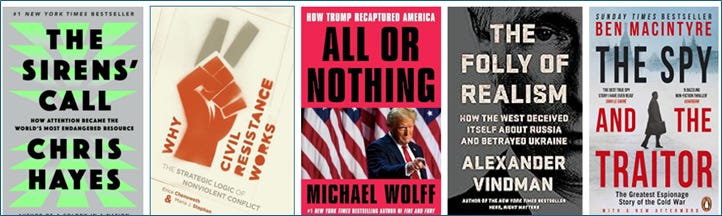
I read Hayes's book a couple of weeks ago. It explains a lot, including much of Trump's behavior. Children deprived of parental attention will often misbehave to get attention they can't get by behaving. Trump often reminds me of a toddler. I recommend the book,