
When The Statues Fall: Trump’s War Accelerates The Arrival Of Renewable Energy

When The Statues Fall: Trump’s War Accelerates The Arrival Of Renewable Energy
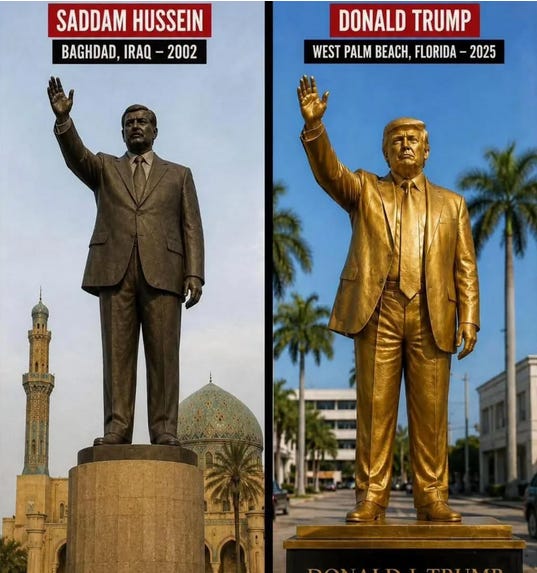
Trump’s war with Iran is accelerating two world-shaking revolutions: the end of the ‘American Age’, and the replacement of fossil fuels with renewable energy.
Trump did not anticipate that either consequence would happen; he would be horrified if he realized the results of his actions.
But they are larger-scale global versions of an event that happened earlier: the unanticipated (to him) results of Saddam Hussein’s invasion of Kuwait. Iraq was taken over and he was executed. His statue came down. So will Trump’s Cause and his identical golf course golden idol – but that is a miniscule side-effect.
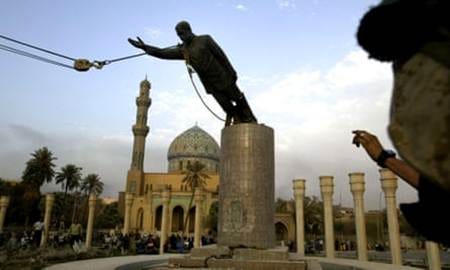
One down…
Both of the new revolutions will underscore the reality that big change can take place quickly.
What is commonly accepted as a norm today, will seem antiquated to us in a year.
But we are a generation the started with wall-phones and graduated to cell-phones;
Starting with the cost to the US of the American-Israeli attack on Iran, Robert Kagan writes in The Atlantic that “The global adjustment to a post-American world is accelerating.”
By this he means that:
· Iran now owns the Strait of Hormuz – regardless of what Trump does - and is a power equal to the US in the region;
· Europe’s offer to conduct ships in the Strait is firmly dependent on Iran’s approval, so ‘The West’ has publicly acknowledged Iranian supremacy;
· The Gulf states plainly exist at the forbearance of Iran, and are otherwise Western constructs; and
· All other powers now question America’s staying power, due to the revealed lack of munitions and ‘modern’ weapons (aircraft carriers are so last war…)
On this final point, I would add that America’s lack of munitions is owed to profit-taking by corporations combined with unlimited support for Israel. American weapons are vastly more expensive than weapons produced elsewhere of equal or better quality. The drain on the weapons supply used to include Ukrainian demand, but that country is self-sufficient now, thanks to Trump’s policies of refusing aid.
The regional power balance has shifted so that the only ‘immediately present’ powers able to match Iran are Egypt and Pakistan. Turkey would also qualify but it is not (as yet) tangled in the war, although with Israel present anything is possible.
Let me emphasize that I don’t believe that America’s drop to the rank of a Middle Power means there will be more conflict in the world, or less order.
Dozens of alliances have popped up around the world that establish new patterns of trade and new friendships, and more are proposed. Former Chief of NATO, Anders Fogh, now encourages Canada, Europe (including Ukraine), Australia, New Zealand, South Korea and Japan to form their own military alliance without the US. He said: ‘’We need a new alliance that can speak up against Trump and MAGA.’‘
So not all alliances are about trade. Some are just about putting down Trump.
Again, Trump is doing some inadvertent good in the world!
More countries are becoming democratic - think Hungary – and are happier with their assertion of self-confidence. During its time as ‘peak power’, America did not supress global conflict, as the case of Afghanistan will confirm, when a democracy was deliberately destroyed, or in South America as the overthrow of democracies in Chile and Brazil illustrate.
America’s role in world affairs after WW2 was to use the CIA to keep ‘aligned’ governments in place, where that was best for the people or not.
Now, with the passing of that role, we can look forward to an international market-garden of governments, all sharing democratic values and reporting to their own people, not Washington.
This does not mean the passing of American “soft power”, or cultural power. The entire world rejoiced when Artemis II circled the moon. When the Public Sector in America does something good, everyone applauds. Similarly, American entertainment and art will thrive. In a sense, America is forever.
Except its idiotic billionaire-take-all economy. But that is another article for another time.
Big change Number Two: nations still depend on fossil fuels.
That is second effect of Trump’s war against Iran, and a part that is changing fastest. It is perhaps the most significant change due to the Hormuz conflict.
Even as the dust was settling in Iran from Trump’s bombardment, the First Conference on Transitioning Away From Fossil Fuels was held in Santa Marta Colombia. Now, a critical mass of the world economy has pledged to work together to phase out fossil fuels, a step that scientists have long said is imperative to limit global temperature rise to an amount civilization can survive.
Some 57 countries, representing most of the biggest economies on Earth, have pledged to phase out burning oil, gas, and coal. These 57 countries — including Germany, the United Kingdom, France, Italy, Brazil, Canada, and Spain, and joined by California, the world’s fifth biggest economy — make up the largest economic bloc on Earth. Their combined gross domestic product of $38.5 trillion (according to April 2026 data from the International Monetary Fund) is larger than the GDP of the US ($32.4 trillion) and almost twice as large as that of China ($20.9 trillion).
As demand for these fuels drops, the basic laws of economics say the prices should drop as well. That may not happen with fossil fuels, because there is a very expensive infrastructure that needs to be continuously supported. If the price of fossil fuels stays the same, and renewable prices continue to drop, the end of the carbon economy may be much closer than people expect.
This will be a disaster in countries like Russia, whose economy has been described as a gas station with a few in-store trinkets.
The countries transitioning from a petro-state are off to a promising start. For the first time ever, solar and wind generated more electricity globally than coal. As coal declines, renewable energy is rapidly reshaping the planet with cleaner air, cheaper power, and a greener future.
Other powers have already accelerated their plan to reply on self-made renewable energy. Uruguay is a global leader in renewable energy, producing nearly 99% of its electricity from renewable sources. Paraguay is also at 99.7%.
The biggest and fastest energy conversions are in vehicles. This is what happens when Israel and the United States destabilize global oil and natural gas supplies for the foreseeable future.
According to Morning Overview: “For the first time, more than half of all new cars sold in China in 2024 were electric or plug-in hybrid vehicles, a milestone that energy researchers have long identified as the point where a technology shift becomes self-sustaining. In Europe, a binding law now guarantees that every new car sold after 2035 must produce zero tailpipe emissions. Together, the world’s two largest auto markets outside the United States have crossed what analysts call a tipping point, and the consequences are rippling through the global car industry.”
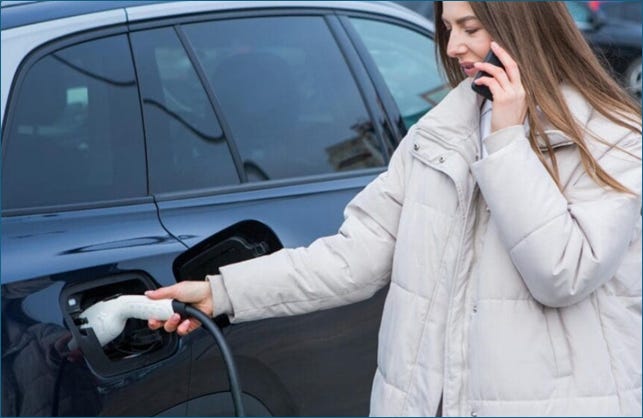
For owners of gas-powered cars, the recent conflict signals an ongoing geopolitical volatility in the heart of oil country that may not subside. The question is no longer whether EVs will dominate the market but how quickly gasoline models will be pushed to the margins.
While American drivers have been complaining about high prices, in the Netherlands and Denmark consumers are already paying the equivalent of around $10 a gallon. Philippines President Ferdinand “Bongbong” Marcos, Jr., recently declared a national energy emergency, as his country had only a little over a month’s worth of petroleum left.
Electric vehicle (EV) sales and interest experienced a significant surge in March and April 2026, following the closure of the Strait of Hormuz.
In Europe, new battery-electric vehicle (BEV) registrations rose 50% in March. Gas and diesel vehicles now account for only 30% of the Euro-market.
According to Euronews:
“The Iran war and the consequent blockade of the Strait of Hormuz have created sustained pressure on global energy markets, leading to high and unpredictable prices for traditional fuels.
“These external factors are effectively penalising owners of petrol and diesel cars, making the lower running costs of EVs increasingly attractive to European motorists.
“If the conflict prolongs, it is expected that the trend of new buyers increasingly favouring EVs will continue, as it alienates consumers from the increased costs.”
In some Euro-nations, EVs are already on top of the market. Norway is the global leader in electric vehicle (EV) adoption, with over 95% of new cars sold in 2025 being fully electric. In the United Kingdom, EV sales spiked a record 24% in March.
The United States and China, the world’s two largest economies, have both seen a surge in EV sales.
Chinese manufacturers reported an 82.6 percent rise month-over-month. In 2024, it produced more than 12 million electric, hybrid, and fuel-cell vehicles (also known as “New Energy Vehicles”). That figure amounts to 70% of global production. EVs accounted for more than half of new car registrations in China last year. Moreover, China already has the ability to produce 20 million EVs annually.
Japan’s EV sales nearly tripled year-on-year last month.
South Korea saw domestic purchases surge by 172 percent.
In Australia, EVs accounted for 14.6 percent of total vehicle sales in March, nearly double the proportion recorded during the same period the previous year.
Could be good for America. If it is not the golden icon in he middle of the field, it is dynamic – it can change with less regard to the threads tying it to other consequences.
EV sticker prices continue to fall. New discoveries of lithium resources and new, less expensive batteries also promise to bring their prices down even further. Moreover, China’s Contemporary Amperex Technology Company (or CATL), a giant battery manufacturer, has just announced that it has developed a new battery that will enable an electric vehicle to travel 932 miles on a single six-minute charge.
The future is EV.
the latest horrific Iran war is also helping to change the world forever in ways that could prove positive indeed.
The big winner will be our planet.
A global environment in a fully realized green economy will be characterized by a stabilization of planetary temperatures, dramatically improved air and water quality, and the restoration of natural ecosystems.
By substituting fossil fuels with renewable energy and transitioning to a circular economy, the environment will shift from a state of rapid degradation to one of regeneration.
The atmosphere will be stabilized, ecosystems will regenerate, air and water will be cleaner, coastal areas will no longer be subject to chaotic flooding, and forests will rebound.
All this, because Donald Trump is an idiot.
Never discount the usefulness of stupidity.
People who are not capable of calculating negative consequences sometimes engage in a form of “intellectual recklessness” that “intelligent” person might deem too risky.
On the other hand, we have to stop asking Trump, “how stupid can you possibly be?” He seems to take it as a challenge.
Further, in his second term as president, he is no longer surrounded by a guard rail of people who could mute his madness. Now he has picked his own advisers, based on the time it takes them to say “yes”.
Hillary Clinton once wrote an op-ed with the headline: “How Much Dumber Will This Get?” “It’s not the hypocrisy that bothers me,” Clinton wrote, “it’s the stupidity.”
It is so bad that we forget the incidents. We are beset by shambolic incompetence of a degree that led the editor of the Atlantic magazine to be accidentally added to a Signal group chat about US military operations. We even try to make up reasons for the stupidity, because we cannot bear the thought that it might be just casual. Tariffs, for example, surely must be part of a grand plan to crash the dollar in the interest of the billionaire class. They can’t just be stupid?!
Yes, they can.
And the closure of the Strait of Hormuz is not part of a big scheme to save the environment or transfer to a globally balanced world.
Stupidity has consequences.
Sometimes good.
The trick with Trump, is to find ways of erasing the ones like income inequality or healthcare crises, before they crush us all.
If we can stop him in November, we will have accidently hit the timing right. Most of the ill-effects of his planned economic disaster are timed for after those elections.
If we stop his bus, we can remove the dangerous demons while letting the economy transform to a green and renewable resource.
It’s no way to run a country, but we have allowed a deranged man to get into the highest office, backed by a coterie of dim and unqualified cronies.
It’s the only chance we have.
It just happens to be a chance with an up-side.
We are the last generation to know what it was like as a kid to play outside, instead of online; to grow up without social media; to have playgrounds, not passwords; to know a non-digital world.
To know what gasoline powered cars sounded like.
Wait for it…
ADVANCE NOTICE: For some weeks in early June I will be on vacation, and my articles will no longer be written daily. I appreciate your understanding. Thank you for following Barry’s Substack, focusing on the meaning behind the headlines. A regular summary of a topical book every few weeks helps full subscribers stay ahead of the conversation.
PS - If you have enjoyed this article, please subscribe or consider buying me a coffee.
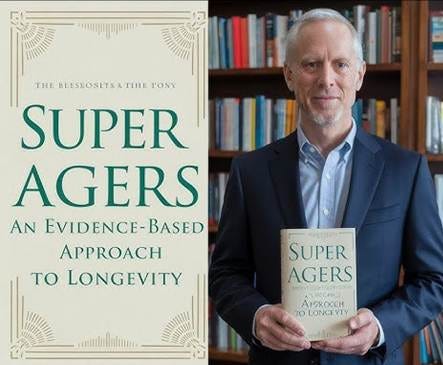
In the next two weeks we will look at SUPERAGERS – An evidence-based approach to longevity.
Recent features have delved into:

There is no question the felonpotus has accelerated the decline of US superpower status. We are not reliable, trustworthy, or have competent leadership. We will get those three back when the Republican stranglehold is broken, but our status will not be above everyone else; we must have parity partners in trade, security, and democratic norms. Economies will depend upon multilateral allies; the dollar may wind up being equal to the yuan, the euro, the rupee. It is probably best for the world to have no superpowers. Military might has changed. Lumbering sea and aircraft will cede to electronics, such as drones. Renewables, as your essay describes, will be paramount for energy needs. Perhaps a new model for more equitable incomes of people will erase the hoarding class, the billionaires who seek to control all the world's wealth and resources, leaving little to nothing for 95% of us non-millionaires. A billionaire run earth is no future for humanity.
Wake up call to Taiwan…, seeking sovereign independence and security life support from the trump administration is not time well spent.
Call. Send you best delegation. To Ukraine. A country with the technology, the intelligence, moral conviction and reliability to be a potential ally - something harder to find lately in these challenging, evolving times.
There’s probably a great deal that could be had in trading high value chips for superpower stopping drones.